



CD3 Protein - A hot target for bispecific antibody
T cell bispecific antibodies (TCBs) are molecules that are engineered to include binding sites to the T cell receptor (TCR) and to tumor-associated or tumor-specific antigens within a single entity. One of the most widely studied TCBs in cancer immunotherapy is CD3, a molecule that has the function of stabilizing TCR structure and transmitting activation signals.
Antibodies against CD3 molecules can stimulate or block T cell activation signal transduction. In addition, these antibodies can eliminate effector T cells or induce a regulatory phenotype in T cells thus, providing a new method for the treatment of organ transplant rejection and autoimmune diseases. These CD3 molecules bind to TCR non-covalently to form a TCR/CD3 receptor complex on the surface of the T cell.

There are 4 subtypes of CD3, including CD3δ, CD3ε, CD3γ, and CD3ζ. CD3δ/CD3ε and CD3γ/CD3ε can form the TCR-CD3 complexes through the α/β chain of TCR as heterodimers. CD3-targeted therapeutic antibody usually recognizes the CD3ε in the heterodimer complex to activate the anti-tumor activity of T cells. However, in the process of recombinant expression, CD3ε and CD3δ can randomly form incorrect heterogeneous complexes, which may lead to the loss of bioactivity and high batch-to-batch inconsistency.
To accelerate the research and development of bispecific antibodies, ACROBiosystems has developed a series of homogeneous CD3δ/CD3ε and CD3γ/CD3ε proteins with high bioactivity. These proteins are verified as a 1:1 heterodimer by nonreductive electrophoresis and MALS respectively. In addition, customer data suggests that bispecific antibody products from ACROBiosystems can be used in applications including, but not limited to clinical pharmacokinetics, therapeutic antibody screening, identification, and characterization.
Successively, our superior CD3 product quality helped accelerate the clinical development of a bispecific antibody into a therapeutic. Click here to download CD3 poster.
Product Features
 Larger product catalog
|
5 molecules: CD3ε& CD3δ, CD3ε& CD3γ, CD3ε, CD3δ, CD3γ |
|
Various tags: His, His&Avi, Fc, Llama Fc, Flag |
|
Various species: Human, Mouse, Cynomolgus, Rat, Rabbit |
Homogeneous structure: CD3ε& CD3δ and CD3ε& CD3γ are verified as 1:1 heterodimers by non-reductive electrophoresis and MALS
High bioactivity verified by binding with common antibodies such as OKT3, SP34-2, UCHT1 and BCMA×CD3
High batch-to-batch consistency guaranteed by strict quality control
Suitable for different applications including antibody immunotiter detection, biopanning, antibody screening, affinity characterization and clinical pharmacokinetic assay
 Order
OrderMore BsAb targets
Click the molecule to find out your interesting products.
Click to learn more about bispecific antibody targets and services.
Bioanalytical assay development service
CD3-targeted bispecific and trispecific antibodies represent a fast-growing field in therapeutic antibody development. However, selecting the appropriate detection reagents for custom bioanalytical assays such as ELISAs is challenging. With an abundant selection of CD3 proteins including labels and tags, companies may struggle in developing a highly sensitive and specific assay for their drug therapy.
Here at ACROBiosystems, we can provide a large product catalog of highly bioactive CD3δ/CD3ε, CD3γ/CD3ε products as well as our expertise and our ISO17025-accedited analytical service platform. Using our analytical service platform, we offer customized services from paired protein screening to ELISA-based assay release method development, validation, and kit development to help accelerate your R&D process!
Case Studies

Immobilized Human CD3E&CD3D Heterodimer Protein, Fc Tag&Fc Tag (Cat. No. CDD-H5255) at 1 μg/mL (100 μL/well) was spiked with different concentrations of bispecific BCMA×CD3 T cell-engaging Antibody. The identified linear range was found to be 0.8-6 ng/mL.

Immobilized Human BCMA, His Tag (Cat. No. BCA-H522y) was bound to a 96-well plate. Increasing concentrations of bispecific T cell Engager (CD3 X BCMA) spiked in 10% human serum and Biotinylated Human CD3E&3D Heterodimer Protein, His,Avitag&Tag Free (Cat. No. CDD-H82W6) at 0.2 μg/mL was added to each well. Detection was performed using HRP-conjugated streptavidin with sensitivity of 15 ng/mL.

Flexible assay designs and report formats for your personalized needs
ACRO proteins are supplied for free
Only samples are required for service completion
Inquiry and order
-
ACROBiosystems scientist will respond within 24 hours of submission.
-
Call us at: +1 800-810-0816 or email at services@acrobiosystems.com for consultation.
Data
1:1 heterodimer verified by nonreductive electrophoresis and MALS
ACROBiosystems has developed a series of homogeneous CD3 proteins with good bioactivity, which are verified as 1:1 heterodimer by nonreductive electrophoresis and MALS.
-

-
Fig.1 Human CD3E&CD3D Heterodimer Protein (Cat. No. CDD-H52Wa) on SDS-PAGE under reducing (R) and non-reducing(NR)condition and the purity of the protein is greater than 95%. The purity of the protein is more than 85% and around 80-90 kDa verified by SEC-MALS.
-
High binding ability and low batch-to-batch differences
These verified authentic 1:1 heterodimer proteins show high bioactivity in different applications. The products are homogenous with strict quality control to guarantee the minimal batch-to-batch differences.
-

-
Fig.2 Immobilized Biotinylated Human CD3E&CD3D Heterodimer Protein, His,Avitag&Tag Free (Cat. No. CDD-H82W6) at 1 μg/mL (100 μL/well) on Streptavidin (Cat. No. STN-N5116) precoated (0.5 μg/well) plate, can bind Monoclonal Anti-Human CD3 Antibody, Mouse IgG2a (Cat. No. CDE-M120a) with a linear range of 0.2-6 ng/mL (QC tested), and batch differences EC50<0.0001 μg/mL.
-
Designed for different applications of drug development
These products are suitable for various applications at different stages of drug development, such as antibody immunotiter detection, biopanning, antibody screening, affinity characterization and clinical pharmacokinetic assays.
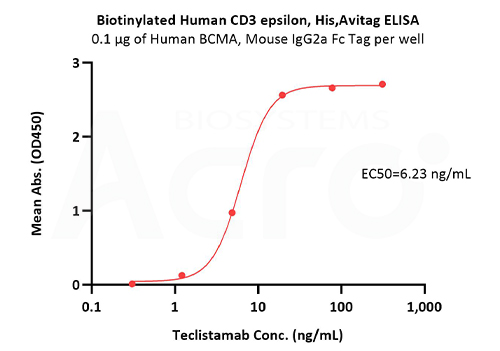
Immobilized Human BCMA, Mouse IgG2a Fc Tag (Cat. No. BCA-H5253) at 1 μg/mL, add increasing concentrations of Bispecific T cell Engager (CD3×BCMA) and then add Biotinylated Human CD3 epsilon, His,Avitag (Cat. No. CDE-H82E1) at 0.2 μg/mL. Detection was performed using HRP-conjugated Streptavidin (Cat. No. STN-NH913) with sensitivity of 6.23 ng/mL (Routinely tested).

Bispecific T-cell Engager (CD3×DLL3) captured on Protein A Chip can bind Human CD3 epsilon, His Tag (Cat. No. CDE-H5223) with an affinity constant of 0.843 nM as determined in a SPR assay (Biacore 8K).

Immobilized Human CD20 Full Length Protein, His Tag (Cat. No. CD0-H52H3) at 2 μg/mL, add increasing concentrations of Glofitamab and then add HRP-Human CD3E&CD3D Heterodimer Protein, His Tag&Tag Free (Cat. No. CDD-HR2W3) at 1 μg/mL. Detection was performed using HRP-conjugated Streptavidin (Cat. No. STN-NH913) with sensitivity of 40.30 ng/mL (Routinely tested).

Immobilized Human CD20 Full Length Protein, His Tag (Cat. No. CD0-H52H3) at 2 μg/mL, add increasing concentrations of Glofitamab and then add Biotinylated Human CD3 epsilon, His,Avitag (Cat. No. CDE-H82E1) at 0.2 μg/mL. Detection was performed using HRP-conjugated Streptavidin (Acro, Cat. No. STN-NH913) with sensitivity of 41.71 ng/mL (Routinely tested).

Immobilized Human BCMA, Mouse IgG2a Fc Tag (Cat. No. BCA-H5253) at 1 μg/mL, add increasing concentrations of Teclistamab and then add Biotinylated Human CD3E&CD3G Heterodimer Protein, His,Avitag&Tag Free (Cat. No. CDG-H82W3) at 1 μg/mL. Detection was performed using HRP-conjugated Streptavidin (Cat. No. STN-NH913) with sensitivity of 20.12 ng/mL (Routinely tested).

Immobilized Human DLL3, His Tag (Cat. No. DL3-H52H4) at 0.2 μg/mL, add increasing concentrations of Tarlatamab and then add Biotinylated Human CD3 epsilon, His,Avitag (Cat. No. CDE-H82E1) at 0.2 μg/mL. Detection was performed using HRP-conjugated Streptavidin (Cat. No. STN-NH913) with sensitivity of 8.21 ng/mL (Routinely tested).
-

-
Immobilized Human BCMA, His Tag (Cat. No. BCA-H522y) at 2 μg/mL, add increasing concentrations of Bispecific T cell Engager (CD3×BCMA) in 10% human serum and then add Biotinylated Human CD3E&CD3D Heterodimer Protein, His,Avitag&Tag Free (Cat. No. CDD-H82W6) at 0.2 μg/mL. Detection was performed using HRP-conjugated streptavidin with sensitivity of 15 ng/mL.
-
FAQ
How do I choose between human and cynomolgus CD3 proteins when validating cross-species reactivity for bispecific T-cell engagers (TCEs)?
How can I mitigate the risk of tag interference or steric hindrance when immobilizing CD3 proteins in SPR/BLI kinetic assays?
What measures are implemented to ensure the lot-to-lot consistency of CD3 proteins during long-term, multi-phase drug discovery campaigns?
How is the high biological activity of the recombinant CD3 proteins demonstrated? What representative antibodies are used by ACROBiosystems as positive controls?
What is the clinical significance of ACROBiosystems’ full-length TCR-CD3 complex proteins for the development of next-generation, low-toxicity T-cell engagers (TCEs)?
- Background
- Product Features
- Product List
- More BsAb targets
- Bioanalytical assay development service
- Data
- FAQ