


Biotinylated Human NY-ESO-1 TCR & CD3E & CD3D & CD3G & CD3Z Full Length Protein, His,Flag&Avitag™ (Nanodisc-Pro)

AIDD‑Ready
Cat. No. / Size
Price
Availability
Qty
NYZ-H82D3-20ug
$1,020.00
In Stock - Delivery in 1-2 business days
NYZ-H82D3-100ug
$1,820.00
In Stock - Delivery in 1-2 business days
NYZ-H82D3
Sub-Total :
$ 0
Customize Product Request Quote
Contact Us
Contact Us
Sub-Total:
$ 0
  • Product Details
  • Performance Data
  • Reviews & Citations
  • Important Statement
  • Resources
Application
  • Cell based assay (FACS or functional assay)
  • Affinity testing (SPR / BLI)
  • Screening (ELISA)
Synonyms

NY-ESO-1 TCR & CD3E & CD3D & CD3G & CD3Z

Source

Nanodisc Biotinylated Human NY-ESO-1 TCR & CD3 Full Length Protein, His,Flag&Avitag (Nanodisc-Pro) (NYZ-H82D3) is expressed from human 293 cells (HEK293). It contains AA (Accession # P07766-1 & P04234-1 & P09693-1 & P20963-1).

Predicted N-terminus: Phe

Molecular Characterization

This protein carries a polyhistidine tag and a Flag tag at the C-terminus, followed by an Avi tag (Avitag™).

The protein has a calculated MW of 67.0 kDa & 80.2 kDa. The protein migrates as 43 kDa,55 kDa,65-70 kDa and 95 kDa when calibrated against Star Ribbon Pre-stained Protein Marker under reducing (R) condition (SDS-PAGE) due to glycosylation.

*The isotype control of empty/mock nanodisc (Cat. No. APO-H81Q5) is sold separately and not included in protein, you can follow the link for product information.
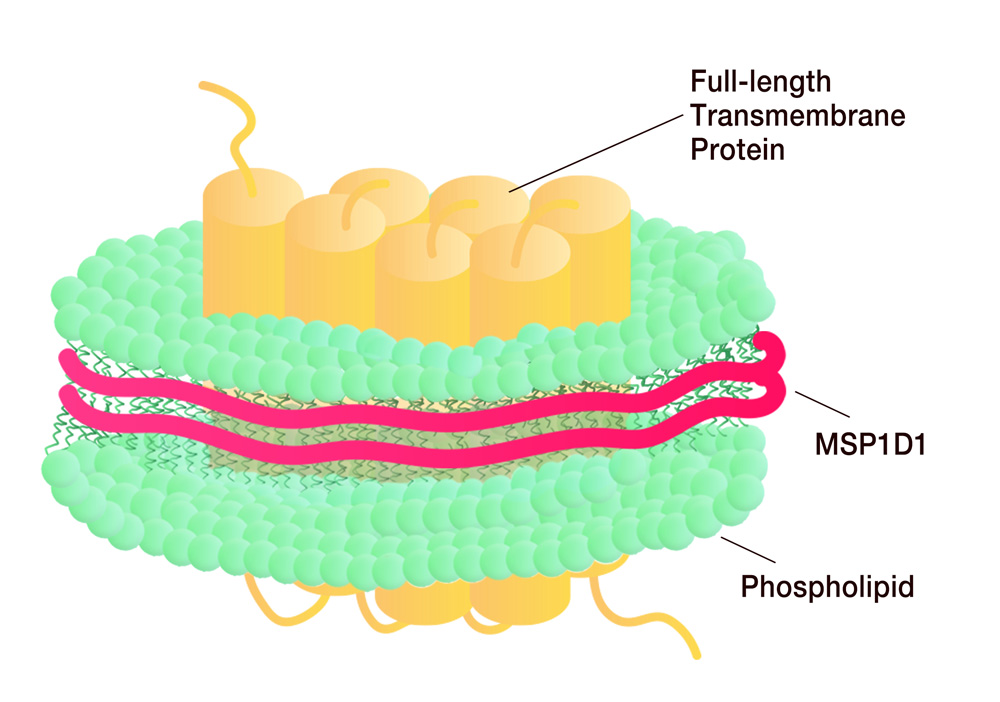
Structure

Nanodisc membrane protein is wrapped by a synthetic phospholipid bilayer membrane structure, composed of membrane scaffold proteins (MSPs) and phospholipids.

Synthesis Process

Nanodisc reconstitution is a self-assembly process that starts from purified, detergent-solubilized membrane proteins and reconstitutes them into synthetic phospholipid bilayers stabilized by MSP1D1 membrane scaffold protein. This creates a stable, detergent-free environment that preserves native conformation and biological activity, with excellent homogeneity and full compatibility with cell-based assays such as FACS and binding assays in antibody discovery and screening (ELISA),etc.

Labeling

Biotinylation of this product is performed using Avitag™ technology. Briefly, the single lysine residue in the Avitag is enzymatically labeled with biotin.

Protein Ratio

Passed as determined by the SABA assay / HABA assay / binding ELISA.

Endotoxin

Less than 1.0 EU per μg by the LAL method / rFC method.

Purity

>90% as determined by SDS-PAGE.

Formulation

Supplied as 0.2 μm filtered solution in 20 mM HEPES, 150 mM NaCl, pH7.5 with glycerol as protectant.

Contact us for customized product form or formulation.

Shipping and Storage

This product is supplied and shipped on dry ice.

Please avoid repeated freeze-thaw cycles.

This product is stable after storage at:
  • The product MUST be stored at -70°C or lower upon receipt;
  • -70°C for 3 months under sterile conditions.

Background

Cluster of Differentiation 3 (CD3) is a pivotal multimeric T cell co-receptor complex essential for adaptive immune responses. Composed of epsilon (ε), gamma (γ), delta (δ), and zeta (ζ) polypeptide chains forming three distinct dimers (εγ, εδ, ζζ), CD3 non-covalently associates with the T-cell receptor (TCR) to establish the critical TCR/CD3 receptor complex on T cell surfaces. Structurally, CD3 proteins belong to the immunoglobulin superfamily, featuring a transmembrane domain, an N-terminal extracellular region with immunoglobulin-like domains, and cytoplasmic tails embedded with immunoreceptor tyrosine-based activation motifs (ITAMs). These ITAMs are fundamental for initiating signal transduction upon T cell receptor engagement, thereby activating both CD4+ T helper and CD8+ cytotoxic T cells. As a defining marker of the T cell lineage, CD3's central role in T cell activation makes its modulation, via stimulating or blocking antibodies, a promising therapeutic avenue for conditions like organ transplant rejection and autoimmune diseases.