Save Product

Product Details
Synonyms
TACTILE
Source
Human CD96 Protein, Mouse IgG2a Fc Tag (TAE-H5252) is expressed from human 293 cells (HEK293). It contains AA Val 22 - Met 503 (Accession # P40200-2).
Predicted N-terminus: Val 22
Request for sequenceMolecular Characterization

Other Tags and Version Biotin & Other Labeled Version
This protein carries a mouse IgG2a Fc tag at the C-terminus.
The protein has a calculated MW of 80.4 kDa. The protein migrates as 130-180 kDa when calibrated against Star Ribbon Pre-stained Protein Marker under reducing (R) condition (SDS-PAGE) due to glycosylation.
Endotoxin
Less than 0.01 EU per μg by the LAL method / rFC method.
Purity
>90% as determined by SDS-PAGE.
Formulation
Lyophilized from 0.22 μm filtered solution in Tris with Glycine, Arginine and NaCl, pH7.5 with trehalose as protectant.
Contact us for customized product form or formulation.
Reconstitution
Please see Certificate of Analysis for specific instructions.
For best performance, we strongly recommend you to follow the reconstitution protocol provided in the CoA.
Storage
For long term storage, the product should be stored at lyophilized state at -20°C or lower.
Please avoid repeated freeze-thaw cycles.
This product is stable after storage at:
- -20°C to -70°C for 12 months in lyophilized state;
- -70°C for 3 months under sterile conditions after reconstitution.
ACRO Quality Management System
Customers Also Viewed
Performance Data
SDS-PAGE

Human CD96 Protein, Mouse IgG2a Fc Tag on SDS-PAGE under reducing (R) condition. The gel was stained with Coomassie Blue. The purity of the protein is greater than 90% (With Star Ribbon Pre-stained Protein Marker).
Bioactivity-ELISA

Immobilized Human CD96 Protein, Mouse IgG2a Fc Tag (Cat. No. TAE-H5252) at 2 μg/mL (100 μL/well) can bind Human CD155, Fc Tag (Cat. No. CD5-H5251) with a linear range of 20-312 ng/mL (QC tested).
Protocol
Bioactivity-CELL BASE
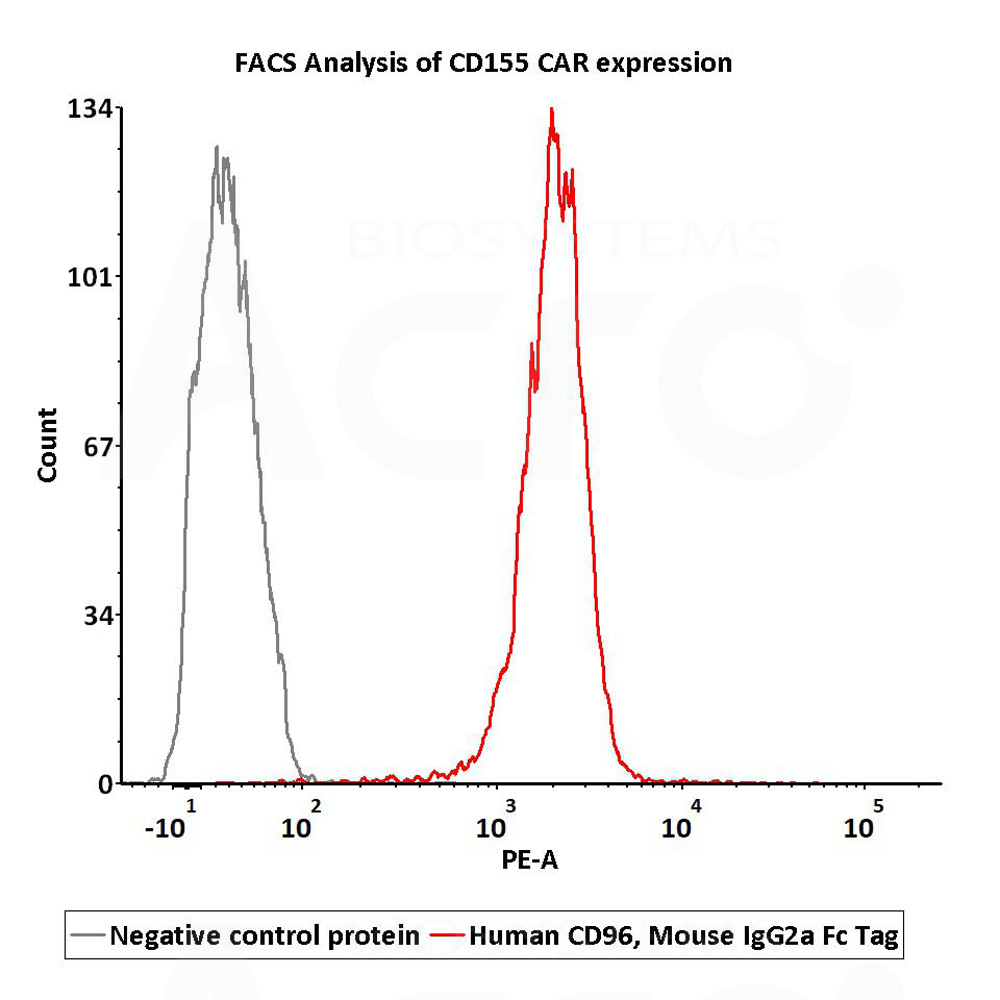
FACS analysis of Human CD96, Mouse IgG2a Fc Tag binding to CD155 cells overexpressing CD155.
2e5 of CD155 cells overexpressing CD155 were stained with 100 μL of 1 μg/mL of Human CD96 Protein, Mouse IgG2a Fc Tag (Cat. No. TAE-H5252) and negative control protein respectively, washed and then followed by PE-anti-Mouse IgG2a antibody and analyzed with FACS (Routinely tested).Protocol
Customer Reviews Writing Reviews

Background
TIGIT and CD96 together with the co-stimulatory receptor CD226 form a pathway that is analogous to the CD28/CTLA-4 pathway, in which shared ligands and differential receptor:ligand affinities fine-tune the immune response. Although the roles of TIGIT and CD96 as immune checkpoint receptors in T cell and natural killer cell biology are just beginning to be uncovered, accumulating data support the targeting of these receptors for improving anti-tumor immune responses. A clear understanding of the immune cell populations regulated by TIGIT and CD96 is key to the design of immunotherapies that target these receptors in combination with other existing immune checkpoint blockade therapies.
The dysfunction of CD96 may trigger C syndrome: A syndrome characterized by trigonocephaly, severe mental retardation, hypotonia, variable cardiac defects, redundant skin, and dysmorphic facial features, including upslanted palpebral fissures, epicanthal folds, depressed nasal bridge, and low-set, posteriorly rotated ears.
Recent Advances
 Drug Development Progress
- English Name:
T-cell surface protein tactile
- Category:
- Approved Drugs:
0 Details
- Drugs in Clinical Trials:
2 Details
- Highest Development Stage:
Phase 2 Clinical
 Contact Us

전화
글로벌: +1 800-810-0816 (무료)
아시아태평양: +86 400-682-2521
 Drug Candidate Licensing