


Bridging ELISA Kits
The core competitiveness of bispecific antibodies (bsAbs) lies in their ability to simultaneously engage two distinct targets with a single molecule, enabling novel mechanisms of action and unique clinical benefits beyond those of monoclonal antibodies or combination therapies. The target-binding capability is a critical determinant of a bsAb's therapeutic efficacy, safety, and the success of its development. The affinity and specificity for both targets are fundamental to triggering key mechanisms, including immune cell redirection and synergistic regulation of signaling pathways, while minimizing off-target effects and providing a robust safety foundation for clinical translation.
An effective evaluation of bsAb binding must consider both the properties of individual targets and the dual-target bridging effect. This capability serves as an essential quality control metric throughout the drug development lifecycle: enabling early-stage screening to eliminate weak candidates, ensuring batch-to-batch consistency during manufacturing, and supporting regulatory submissions with standardized data.
However, accurately assessing the target-binding activity of bsAbs presents significant challenges at each stage of development.
| Traditional Challenges | Features of Ideal Solutions |
|---|---|
|
Single-target assays cannot replicate true “bridging” activity, often leading to misinterpretation of candidates in early screening and inefficient resource use. |
Quantitatively evaluates a bsAb’s simultaneous engagement of both targets, ensuring results accurately reflect biological function and reducing early-stage misjudgment. |
|
In-house methods vary in antigen source, coating conditions, etc., resulting in significant batch-to-batch variability and weak comparability for regulatory submission. |
Highly standardized methods ensure stable and comparable data across time, batches, and operators, supporting process optimization and regulatory submissions. |
|
Multiple assay systems must be developed separately, consuming significant time and personnel, slowing overall project progress. |
Integrated and simplified workflows support high-throughput applications, maintaining data quality while significantly improving efficiency. |
 High risk of functional misjudgment
 Direct assessment of authentic bridging activity
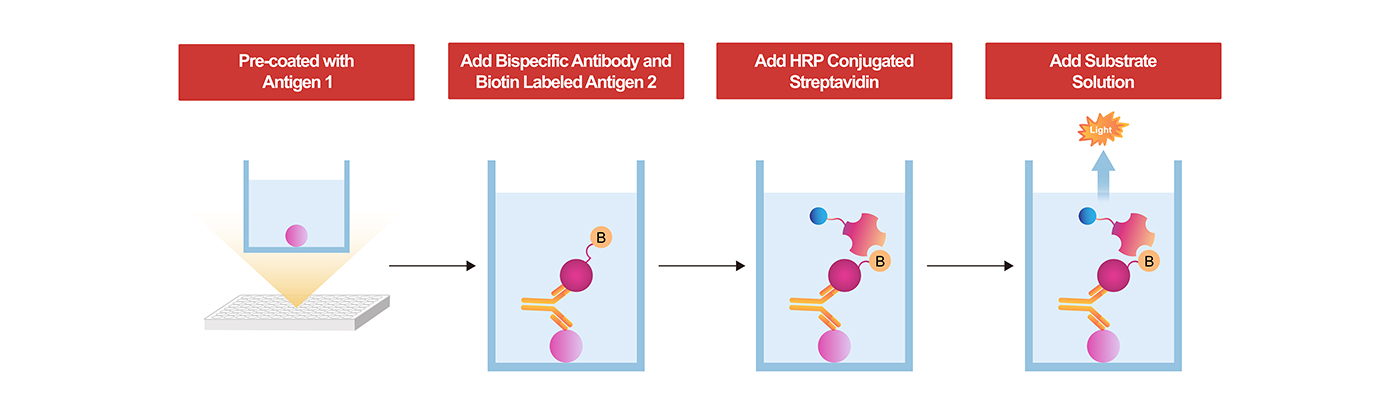
Schematic Workflow of the Bridging ELISA Kits
Product Advantages
 Simultaneous dual-target assessment for real biological activity
Designed based on the bridging ELISA principle, the kit evaluates bsAb binding to both targets in a single system. Results have been validated with marketed drugs, ensuring accuracy and reliability.
Easy, efficient operation for high-throughput screening
Pre-coated plates eliminate manual coating and complex method development, simplifying workflows and enabling high-throughput applications to boost R&D efficiency.
Rigorous quality control ensures batch consistency
Strict QC systems provide excellent batch-to-batch reproducibility, ensuring stable and comparable data for long-term research and quality control.
Comprehensive validation supports regulatory submission
Includes full validation data and standard protocols, facilitating rapid in-house method development and providing strong support for regulatory filings.
High performance with cost efficiency
Delivers excellent detection performance while reducing material and time costs, maximizing R&D value.
Customizable to meet specific needs
Customized development services are available for specific target combinations, precisely meeting diverse and personalized requirements across various bsAb R&D scenarios.
| Service | Deliverables | Timeline |
|---|---|---|
|
Method Development: |
1. Method Development Data 2. Protocol |
2-3 Weeks |
|
Method Validation |
1. Method Validation Report |
4-5 Weeks |
|
Kit Production |
1. Kit Components 2. COA 3. Data Sheet |
2-3 Weeks |
 Order
OrderValidation Data
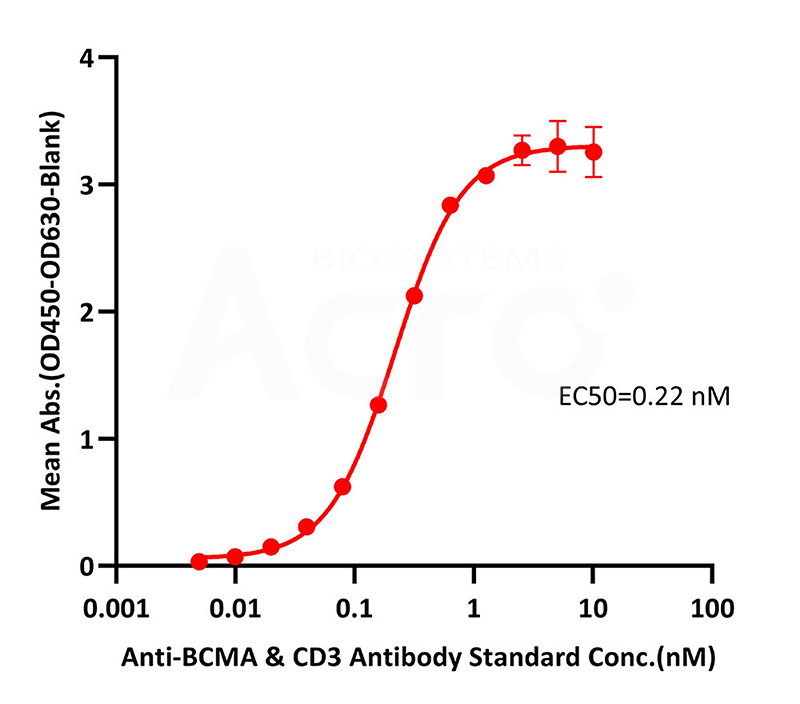
Bispecific Human BCMA & CD3E Bridging ELISA Kit (Cat. No. BIS-A001) can specifically identify Anti-BCMA & CD3 Antibodies, with linear range of 0.010-0.317 nM.
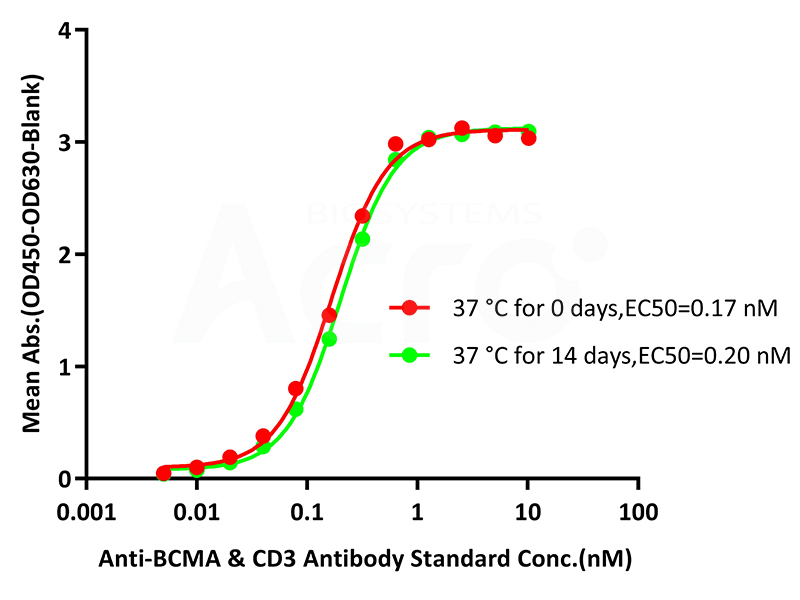
Bispecific Human BCMA & CD3E Bridging ELISA Kit (Cat. No. BIS-A001) was subjected to accelerated testing at 37℃ for 0 days and 14 days, and the RSD of EC50 was 11%.
Related Products Recommendation
- Background
- Product Advantages
- Product List
- Validation Data
- Related Products Recommendation



Online Message
[North America]: 1 Innovation Way, Newark, DE 19711, USA [Switzerland]: ACRObiosystems AG, c/o Zug Dammstrasse Centre AG, Dammstrasse 19, 6300 Zug Switzerland
Email:order@acrobiosystems.com
Copyright © 2025 ACROBiosystems. All Rights Reserved
전화
글로벌: +1 800-810-0816 (무료)
아시아태평양: +86 400-682-2521
주소 서울특별시 송파구 법원로11길 11, 제3층 제비-314,315호