


CRISPR-Cas technology: Targeted Genome Editing Technology
Products
ACROBiosystems focuses on the field of cell and gene therapy. As a leading supplier of recombinant proteins, ACROBiosystems has launched the CAS series nuclease including Cas9 and Cas12a. These proteins are mainly used for targeted gene editing to provide high editing efficiency.
 Product Features:
Available in high concentrations of CAS-9 nuclease:10mg/ml for optimization of editing conditions in more difficult scenarios
High purity:SDS-PAGE & SEC-MALS verified purity > 90%.
Incorporation of nuclear localization signals (NLS) aids delivery to the nucleus, increasing the rate of genomic DNA cleavage
No residual RNase: The production process is strictly free from RNase pollution
Enzyme activity and purity have been inspected in batches. High stability and consistency between batches.
The interactions between prokaryotes and the viruses that infect them have evolved, leading to a wide diversity of CRISPR-Cas systems. CRISPR-Cas systems are generally divided into two categories (Class 1 and Class 2). To date, most researchers have used the Type 2 CRISPR-Cas system, and in this class, the most studied type II is the CRISPR-Cas9 system.
1) Generation of universal allogeneic CAR-T cells; 2) Enhancement of CAR-T cell function
Application of TCR-T cell therapy:
α and β endogenous TCR Gene replacement with artificial tumor-specific TCR sequences for genes
Suppression of immune checkpoint signaling pathways
Screening of new targets for tumor immunotherapy
CRISPR/Cas9 system involves two essential components: target-specific CRISPR gRNA and Cas9 nuclease. In eukaryotic systems, CRISPR/Cas9 is used for genomic editing through specific targeting of DNA by sgRNA, a combination of the CRISPR RNA (crRNA) and the trans-activating crRNA (tracrRNA), mediated through base pairing over the ~20-nt guide sequence [1]. Cas9 recognizes a very short conserved sequence (a few nucleotides in length) adjacent to the guide sequence called the “protospacer adjacent motif” (PAM). Once directed to the DNA target site, Cas9 generates a double-strand break (DSB) that can be repaired either through the indel mutation-introducing non-homologous end-joining (NHEJ) or the high-fidelity homologous directed repair (HDR), resulting in gene knockout effects or template-dependent gene replacement.
 CRISPR-Cas9 regulatory mechanism: Repair of double-stranded DNA breaks by non-homologous end ligation (NHEJ) or homologous directed repair (HDR) endogenously[1]
 주문
주문Assay Data
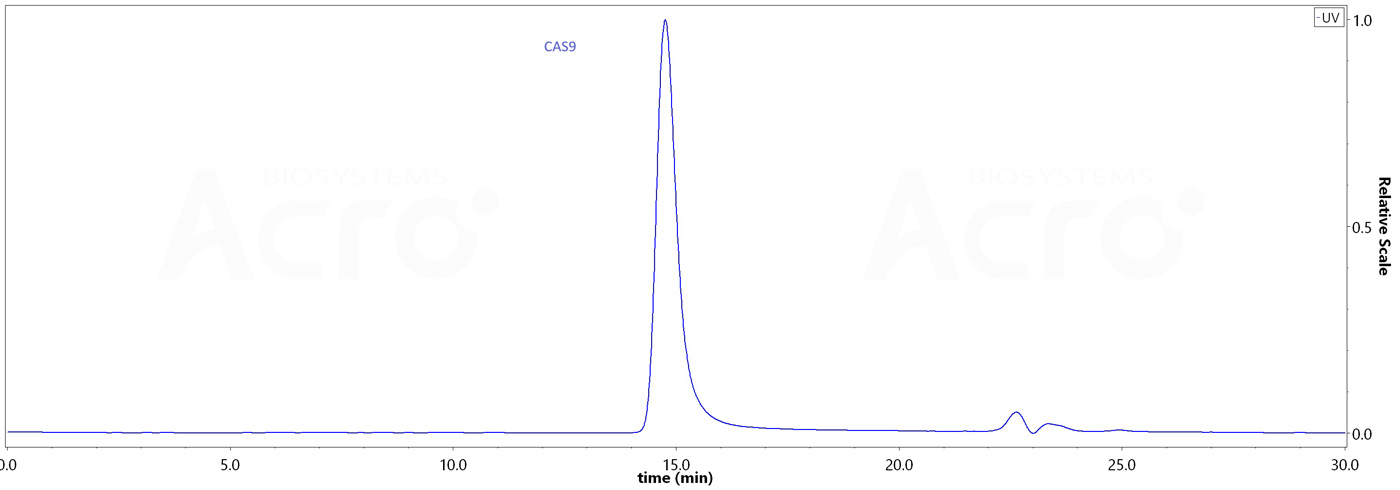
The purity of GMP GENPower™ NLS-Cas9 Nuclease (Cat. No. GMP-CA9S18) was greater than 95% as determined by SEC-HPLC.
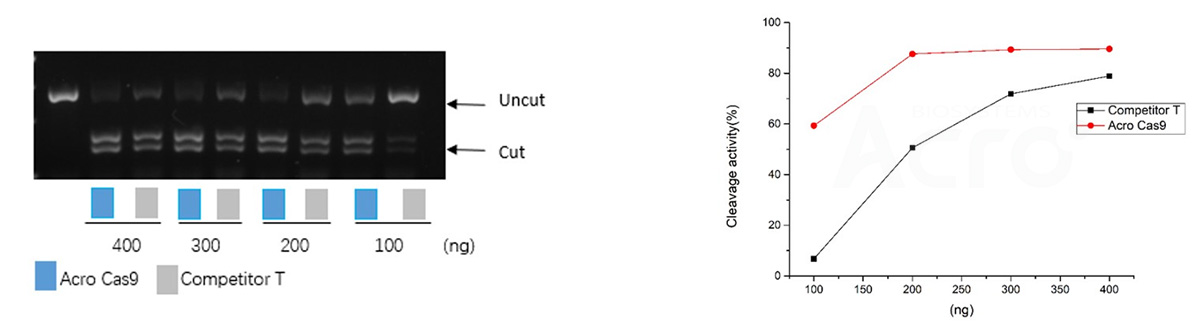
Different amounts of Cas9 were incubated with the same amount of excess gRNA and plasmid for 60 minutes at 37°C. When using 400-200 ng ACRO's Cas9, the cutting efficiency is greater than 90% (QC tested). In comparison, when using a 200 ng CAS9 from company T, the cutting efficiency is only about 50%
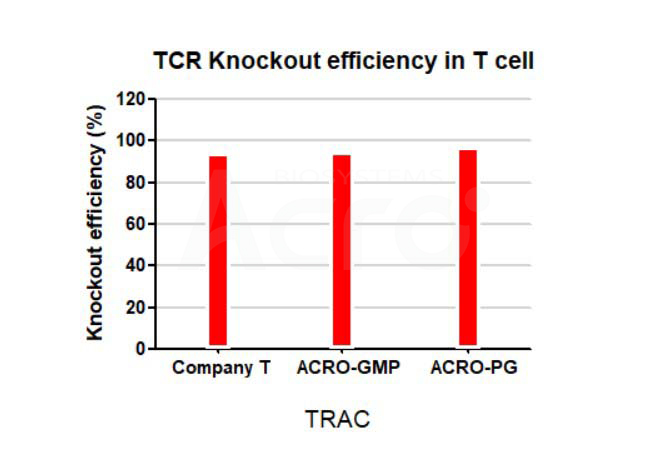
The TCR knockout efficiency with GMP GENPower™ NLS-Cas9 Nuclease in human primary T cells, GMP GENPower™ NLS-Cas9 Nuclease achieved over 95% knockout efficiency.
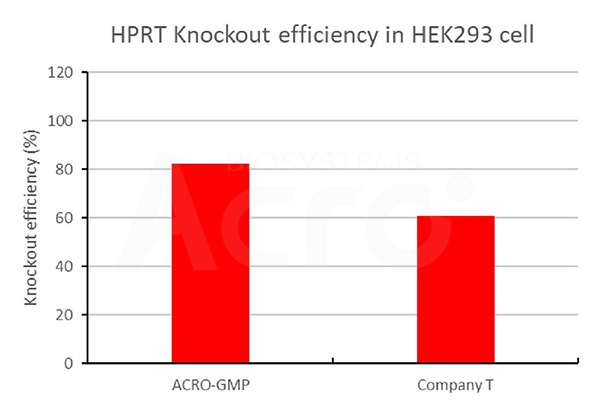
The cleavage efficiency in HEK293 cell 72 hours after electroporation of GMP GENPower™ NLS-Cas9 Nuclease RNP.
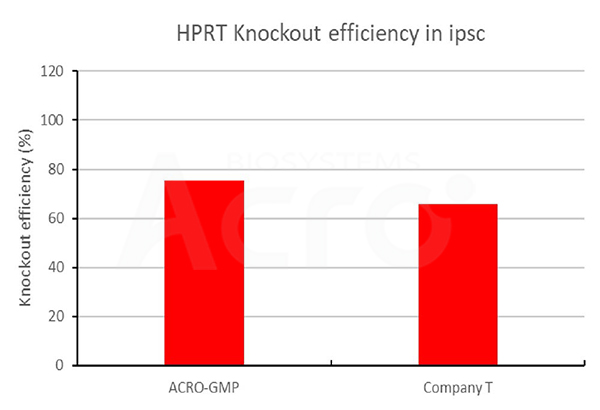
The cleavage efficiency in iPSC 72 hours after electroporation of GMP GENPower™ NLS-Cas9 Nuclease RNP.
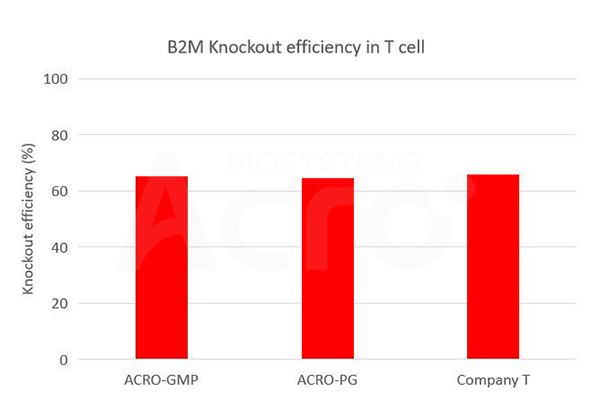
The knockout efficiency for B2M in primary T cell was measured by Flow Cytometry.
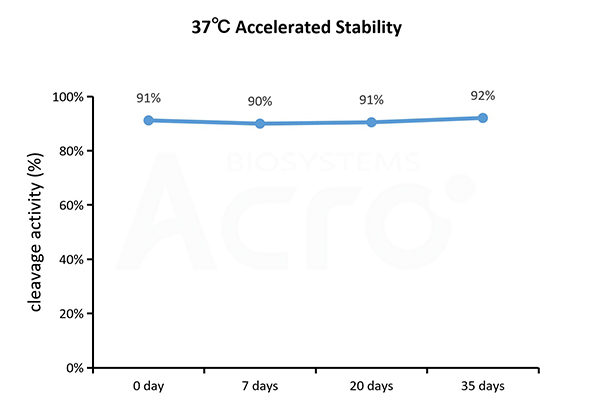
Enzymatic activity assay demonstrates that GMP GENPower™ NLS-Cas9 Nuclease (Cat. No. GMP-CA9S18) is stable at 37°C for 35 days
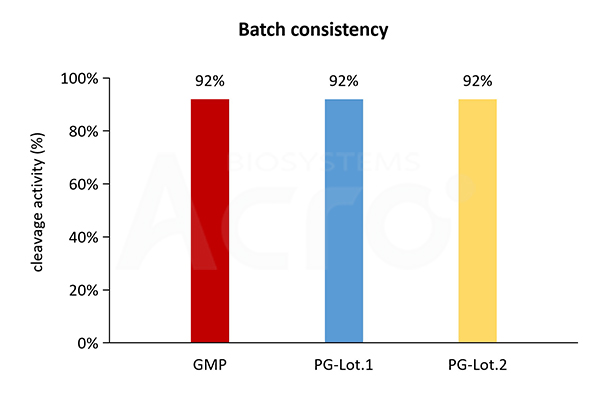
Enzymatic activity assay demonstrates batch-to-batch consistency between Acro's GMP and PG Cas9.
References
-
1. Westermann L, Neubauer B, Köttgen M. Nobel Prize 2020 in Chemistry honors CRISPR: a tool for rewriting the code of life. Pflugers Arch. 2021 Jan; 473(1):1-2.
-
2. Application of CRISPR/Cas9 gene editing in tumor immunotherapy
-
3. Zaib S, Saleem MA, Khan I. CRISPR-Cas9 Genome Engineering: Trends in Medicine and Health. Mini Rev Med Chem. 2022;22(3):410-421. doi: 10.2174/1389557521666210913112030. PMID: 34517795.
- Background
- Products
- Product List
- Assay Data
- References



온라인 메시지
[North America]: 1 Innovation Way, Newark, DE 19711, USA [Switzerland]: ACRObiosystems AG, c/o Zug Dammstrasse Centre AG, Dammstrasse 19, 6300 Zug Switzerland
Email:order@acrobiosystems.com
Copyright © 2025 ACROBiosystems. All Rights Reserved
전화
글로벌: +1 800-810-0816 (무료)
아시아태평양: +86 400-682-2521
주소 서울특별시 송파구 법원로11길 11, 제3층 제비-314,315호