



 Save Product

Product Details
Application
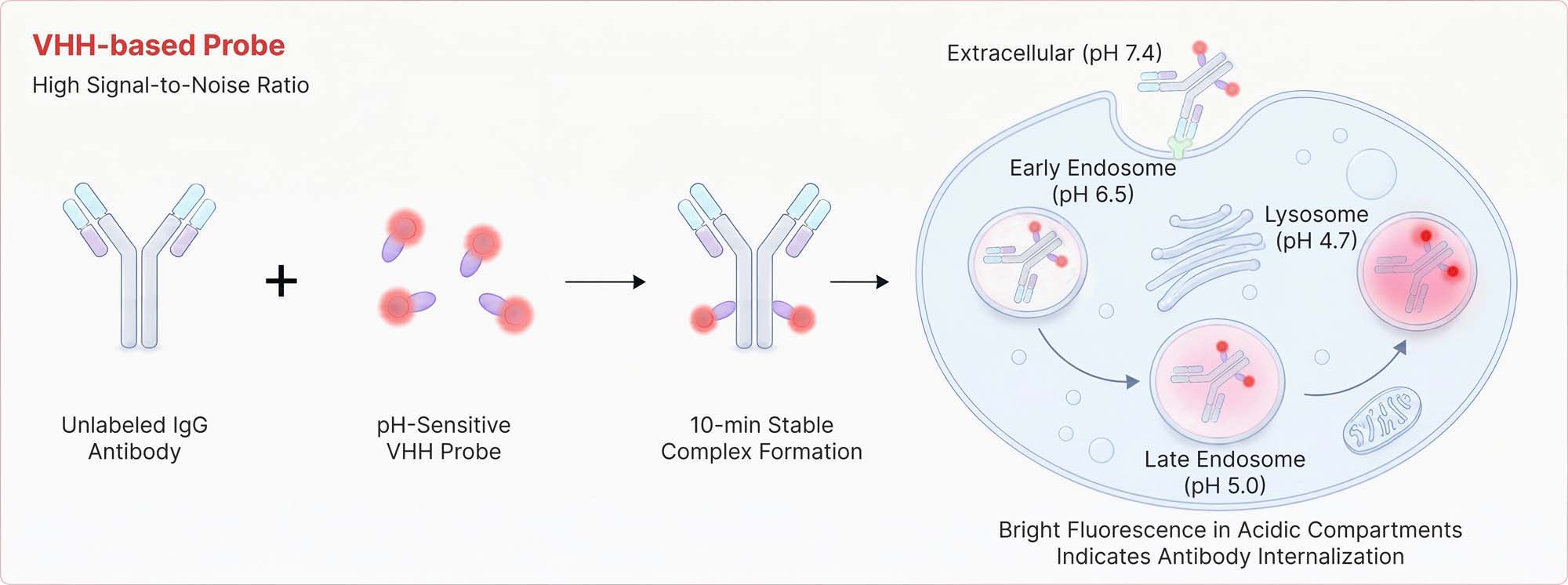
Antibody Internalization Detection Reagent (Cat. No. IGG‑PZF2667) utilizes a VHH single‑domain antibody against human IgG Fc conjugated to a pH‑sensitive fluorescent dye, specially engineered for acid‑triggered signal amplification.
With its smaller molecular weight and low steric hindrance, this reagent specifically binds to the Fc region of human IgG antibodies (IgG1, IgG2, IgG3, and IgG4) to form a stable complex, enabling real‑time monitoring of antibody endocytosis in live cells. The pH‑sensitive dye not only significantly enhances the fluorescence signal in acidic endosomal environments but also effectively minimizes background noise, ensuring high sensitivity and accuracy for internalization detection.Features
- High signal-to-noise ratio - Strong fluorescence with minimal background
- Excellent specificity - High specificity with negligible off-target binding
- Small molecular weight - Low steric hindrance owing to compact molecular size
- Rapid fluorescent labeling - Complete in 10 minutes
- pH sensitive - Bright emission in acidic milieu
- Fc-Specific targeting - Preserves Fab antigen-binding integrity
Specificity
Specifically recognizes the human antibody Fc portion.
Detection Wavelength
Excitation Wavelength: 643 nm
Emission Wavelength: 660 nmStorage
For long term storage, the product should be stored at lyophilized state at -20°C or lower.
Please protect from light and avoid repeated freeze-thaw cycles.
This product is stable after storage at:
- -20°C to -70°C for 24 months in lyophilized state;
- -20°C to -70°C for 3 months after reconstitution.
Assay Principles
ACRO Quality Management System
Customers Also Viewed
Performance Data
Bioactivity-Flow Cytometry
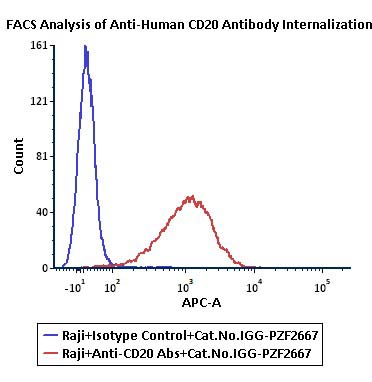
Anti-CD20 Abs and Human IgG1 isotype control were labeled with VHH-Based Antibody Internalization Detection Reagent (Cat. No. IGG-PZF2667). Raji cells were treated with Anti-CD20 Abs-Internalization Detection Reagent conjugate and Isotype control-Internalization Detection Reagent conjugate separately for 4 hours, then analysis by Flow cytometric. APC signal was used to evaluate the activity (QC tested).
Protocol
Fluorescence Imaging
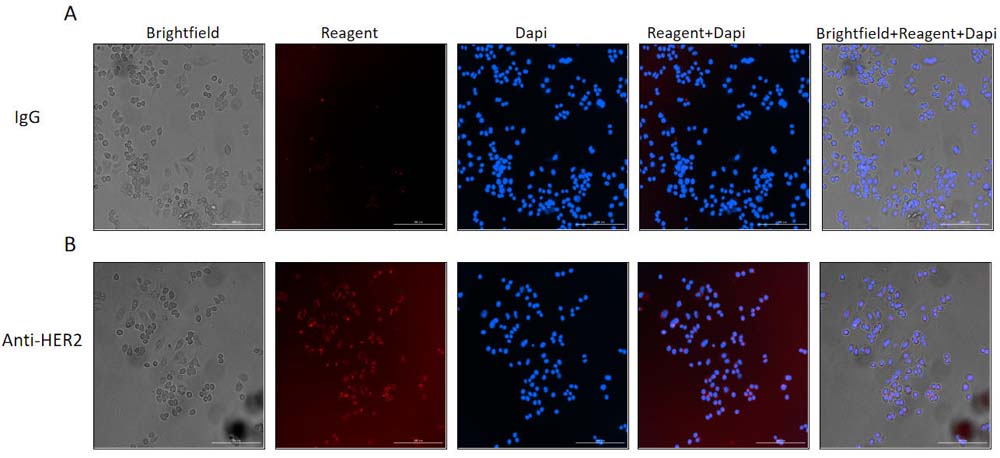
Application of VHH-Based Antibody Internalization Detection Reagent in Endocytosis Detection
SK-BR-3 cells were treated with Anti-Her2 Abs-Internalization Detection Reagent conjugate and IgG1 Isotype-Internalization Detection Reagent conjugate separately for 20 hours (red), then stained with NucBlue Live ReadyProbes (blue) for 20 minutes and imaged on the Cytation 5. A. IgG1 Isotype-VHH-Based Antibody Internalization Detection Reagent .B. Anti-Her2 Abs-Internalization Detection Reagent conjugate.
Customer Reviews Writing Reviews

FAQ
- product
Can lyophilized proteins remain stable during room-temperature shipping or temporary room-temperature exposure?
In general, lyophilized proteins remain stable during room-temperature shipping or temporary exposure to room-temperature conditions.
Many ACROBiosystems recombinant proteins are supplied in lyophilized (freeze-dried) form. The lyophilization process effectively removes moisture from the product, helping reduce degradation-related reactions and improve protein stability during transportation and storage.
To evaluate the stability of lyophilized proteins under normal temperature conditions, ACROBiosystems conducted a stability study on 11 representative lyophilized protein products at 37°C. The study demonstrated that these proteins maintained good quality stability after storage at 37°C for approximately 20 days. Based on these validation results, temporary room-temperature exposure during shipping or handling is generally not expected to have a significant impact on product quality or downstream application performance.
To ensure optimal long-term stability, products should be stored according to the storage conditions specified in the product Certificate of Analysis (COA) upon receipt.
Supporting Document
Recent Advances
 Contact Us

전화
글로벌: +1 800-810-0816 (무료)
아시아태평양: +86 400-682-2521
 Drug Candidate Licensing