

Hamster Lysosomal phospholipase A2 Protein, His Tag

제품 번호/규격
가격
Availability
수량
LY2-H51H3-100ug
$610.00
In Stock - Order by 4 PM ET for overnight delivery on Nov. 18, 2026.
LY2-H51H3-1mg
$3,960.00
In Stock - Delivery in 2 weeks
LY2-H51H3
제품 금액 :
$ 0
신제품 제안 Request Quote
Contact Us
Contact Us
제품 금액:
$ 0
  • 제품 세부정보
  • 데이터 표시
  • Reviews & Citations
  • Important Statement
  • Resources
Synonyms

Lysosomal phospholipase A2

Source

Hamster Lysosomal phospholipase A2 Protein, His Tag (LY2-H51H3) is expressed from CHO cells. It contains AA Val 34 - Pro 412 (Accession # G3HKV9-1).

Predicted N-terminus: Val 34

Molecular Characterization

This protein carries a polyhistidine tag at the C-terminus.

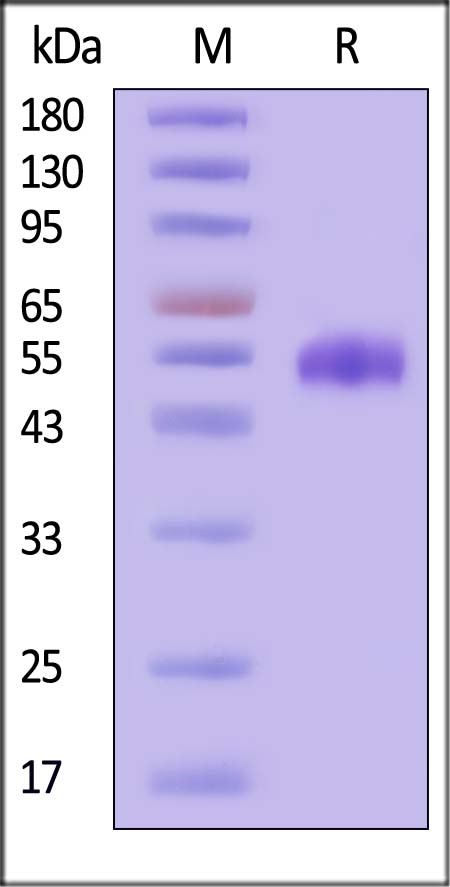
The protein has a calculated MW of 45.4 kDa. The protein migrates as 48-58 kDa when calibrated against Star Ribbon Pre-stained Protein Marker under reducing (R) condition (SDS-PAGE) due to glycosylation.

Endotoxin

Less than 1.0 EU per μg by the LAL method / rFC method.

Purity

>95% as determined by SDS-PAGE.

Formulation

Lyophilized from 0.22 μm filtered solution in 50 mM NaAC, pH4.5 with trehalose as protectant.

Contact us for customized product form or formulation.

Reconstitution

Please see Certificate of Analysis for specific instructions.

For best performance, we strongly recommend you to follow the reconstitution protocol provided in the CoA.

Shipping and Storage

This product is shipped at ambient temperature.

For long term storage, the product should be stored at lyophilized state at -20°C or lower.

Please avoid repeated freeze-thaw cycles.

This product is stable after storage at:
  • -20°C to -70°C for 12 months in lyophilized state;
  • -70°C for 3 months under sterile conditions after reconstitution.

배경 소개

PLA2G15 (also known as LPLA2, Lysosomal Phospholipase A2) is a lysosome-resident phospholipase, requiring critical post-translational modifications (including signal peptide cleavage, N-linked glycosylation, and proteolytic processing) for full enzymatic activation. As a high-risk host cell protein (HCP) in biopharmaceutical manufacturing, particularly from Chinese Hamster Ovary (CHO) cells, it is routinely monitored due to its high immunogenic potential, and its tendency to persist through downstream purification processes due to low clearance efficiency.

ACRO Scientific Leadership Award

Supporting the scientists driving cell & gene therapy forward

Apply Now